Finance, farming and finnovation: Finthropology’s 2025 in review
At Finthropology we work on a broad range of customer-centric finance topics–so broad that it can be difficult sometimes to succinctly summarize our activities. If we’re not doing fieldwork in a far-flung corner of the world, we’re discussing trends at finance conferences or diving into research on topics like cash preferences, children’s use of digital money, gig workers in India or the local politics of cryptocurrency.
In 2025 we also introduced our blog series, Digital Human Finance, which presents qualitative research to showcase the kind of insights that can come from deeper, human-focused studies and how they can be used to build new sustainable financial solutions.
Overall, this year two topics dominated our conversations: farmers’ use of financial tools, and the ways in which AI is shaping financial interactions.
This year, the main project we worked on was Digital Finance and Farming (DiFF), a 5-year, mixed-methods project based at Sydney University that investigates the impact of digital financial services on smallholder farming households in Laos and Cambodia. Now in our fourth year, we have completed household surveys in each country, 123 interviews and several focus groups. We have also begun interviews with stakeholders to identify key issues we need to understand in order to develop great products, programs and policies for smallholder farmers.
To date, some of the project’s key findings are:
Rural households in both Laos and Cambodia are using digital payments, remittances and savings for managing both household finances and farming finances.
Digital credit and insurance are not yet used widely among smallholder farmers in Laos and Cambodia
Households often begin using DFS for household purposes, then incorporate for farming.
Convenience is overwhelmingly the most important benefit of digital financial services identified by our interviewees, followed by access to markets and social payments
We observed a great deal of heterogeneity, with different kinds of use dominating in different villages (e.g. remittances, payments for agriculture or P2P payments)
Women and men use digital financial tools at similar rates, but sometimes for different purposes: women are more likely to use them for household management, whereas men are somewhat more likely to use them for farming
As part of the DiFF project, we organized a session on women’s digital financial inclusion for Inclusive Finance 2025 in Luxembourg. The session’s participants discussed their experiences with how women learn to use digital financial services. It is well-known that women often score lower than men on all kinds of literacy tests, but ‘women’ is also a very diverse group. Tackling women’s digital financial literacy requires acknowledging the diversity of women’s experiences: while social roles may appear similar across regions, their interactions with DFS often differ by service type, community structures, geographic and demographic factors.
This is just one example of how our work is presented at conferences across the globe–whether the European Women Payment Network annual Summits, the EPIC anthropological conference or financial conferences like Finovate Europe, The Banking Scene or Kinfos events. Over the last few years central financial topics have moved from “digital transformation” to “artificial intelligence” in all its forms.
As AI is taking a prominent place in the building of future finance - affecting most processes and organisations, digital solutions are increasingly automated from search tools to customer advice and agentic payments At the same time most people (and businesses) use generative AI tools from search over writing to agentic payments. How do the two meet? And how are they part of peoples financial decisions? We would love our next study to be in this field.
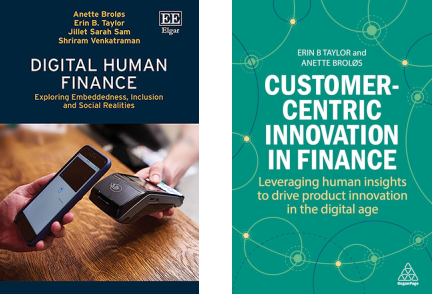
Finally, we are happy to announce that our new book, Digital Human Finance: Exploring Embeddedness, Inclusion and Social Realities (Edward Elgar), will be published in January 2026. Co-authored by Anette Broløs, Erin B. Taylor, Jillet Sarah Sam and Shriram Venkatraman, the book follows on from the conversations we discussed in our last book, Customer-Centric Innovation in Finance: Leveraging Human Insights to Drive Product Innovation in the Digital Age (Kogan Page, 2024). This book goes both broader and deeper in discussing the ways in which people and digital financial services co-create a new kind of financial ecology.
We hope that you enjoy the holiday season–and do let us know what you think of our books, or if you have a cutting-edge project idea that you’d like to share with us.
Erin, Anette and Matt